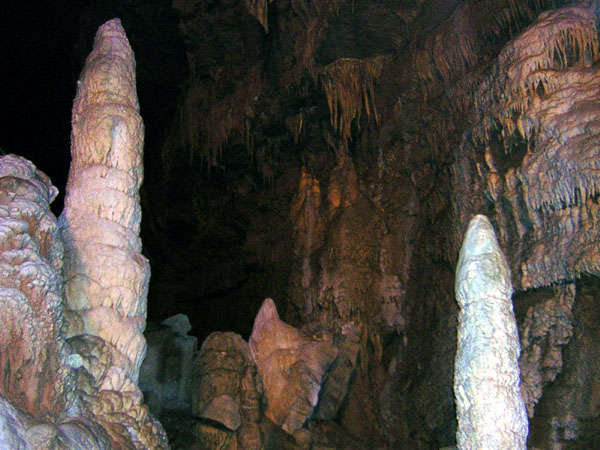
For most of its known history this cave was a hole farmers threw dead livestock down. It was called Grapevine Cave, its only entrance was a long vertical drop, and that drop was used as a rubbish pit.
Virginia Tech turned up in 1942 and made the formal discovery, and surveys in 1946 and again in the 1960s found over a mile of interconnected passage reaching 245 feet below the surface. In 1967 the remains of a prehistoric cave bear, Arctodus pristinus, were dug out of it. The National Park Service registered it as a National Natural Landmark in November 1973, citing its terraced pedestal stalagmites, flowstone, curtains, rimstone, domepits and waterfalls.
In the early 1970s somebody dug a walking entrance, hauled the rubbish out, put in walkways and opened the place to visitors, which is a considerable act of rehabilitation for a cave that had been treated as a pit for generations. The gift shop and entrance were rebuilt in 1981, and later owners rebuilt the lighting properly, because old incandescent lamps grow algae on everything they shine at and that is very hard to undo.
The headline formations are the Snowy Chandelier, a massive compound stalactite, and the Bridal Veil, a broad sheet of flowstone. There is also a record attached to the place: in 1971 a man named Bob Addis sat on top of the War Club stalagmite for 15 days, setting a stalagmite-sitting record that was recognised by Guinness, which is the sort of thing that happened in caves in 1971.
It is just outside Lewisburg, West Virginia, open year round, self guided, and about 120 steps down.
Other places on the map within a couple of hours.
