The gold mine that paid for BP and a medical institute
In 1882 a syndicate set out to mine gold on Ironstone Mountain, 39 kilometres south of Rockhampton in central Queensland. Its members included three Morgan brothers, who gave the mountain its new name, Walter Russell Hall and William Knox D'Arcy. In 1886 they formed the Mount Morgan Gold Mining Company, and the gold proved astonishingly pure, rated 0.998 fine. By 1907 the mine had produced $60 million worth, and for a time it was the largest gold mine in the world. Around it grew a small industrial town of its own, with assay laboratories, workshops, a foundry, a power house and brickworks fed from fireclay caverns dug under the site.
The money travelled. D'Arcy put his share into the search for oil in Persia, which struck in 1908 and became the Anglo-Persian Oil Company, renamed British Petroleum in 1954. Hall left much of his fortune, at his death in 1912, to a trust that founded the Walter and Eliza Hall Institute of Medical Research in 1915.
Underground mining ended in 1927, when fire swept the workings and the company flooded them and went into liquidation. A new company reopened the mountain as an open cut in 1928 and dug until the ore body ran out in 1981, then reprocessed its old tailings until 1990. Over its life Mount Morgan yielded about 262 tonnes of gold, 37 tonnes of silver and 387,000 tonnes of copper, and an estimated 327,000 ounces of gold remain.
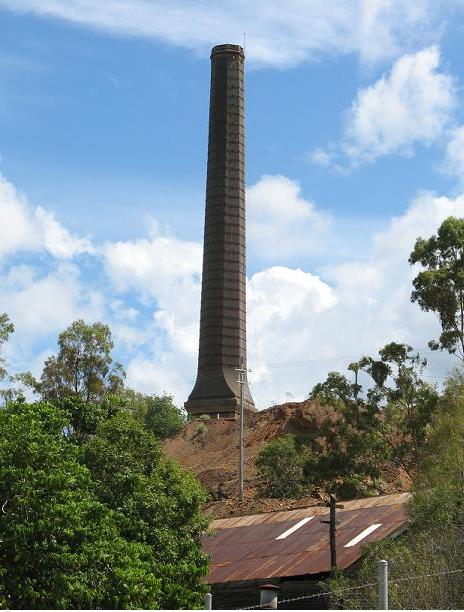
The mine left behind a pit full of acid water rich in copper, aluminium and other metals, run by the Queensland government as an abandoned mine at a cost of about $3 million a year. In January 2013 ex-cyclone Oswald dropped 700 millimetres of rain on the area and the pit overflowed into the Dee River for the first time. At Dululu, 55 kilometres downstream, the river turned a luminous pale green, and farmers watched the fish die. Since then earthworks have cut the risk of another overflow and more than 1,100 megalitres of pit water have been treated, but no government has costed a full clean-up; estimates for even a partial one start at $450 million. A company that proposed reworking the tailings, which local farmers backed as their best chance of a clean-up, withdrew in 2018 over doubts it could pay. The old mine is still a popular attraction, with the General Office, the gold rooms and the main stack standing above the town.
Queensland, Australia
See it on the map
This is remote ground. The closest other places on the map are a long way off.
