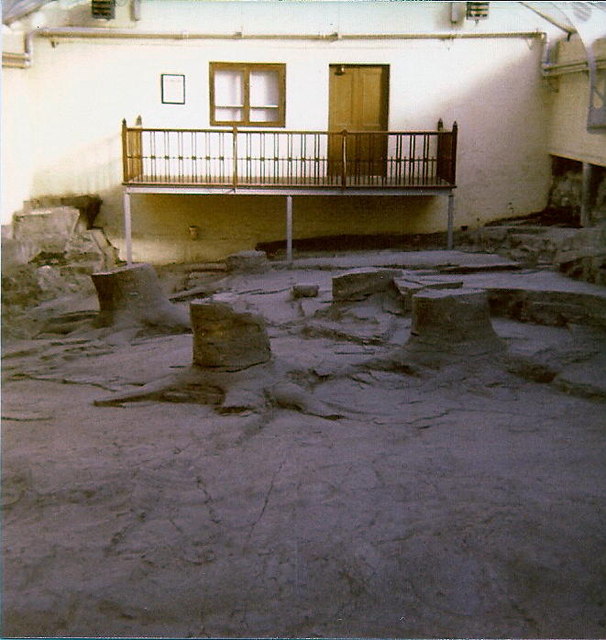
In Victoria Park, Glasgow, eleven stumps of a forest that grew about 325 million years ago still stand where they grew, roots and all. They are Lepidodendron, tree-sized plants sometimes called giant club mosses though closer to quillworts, which grew in a swampy lowland when Scotland lay near the equator. A flood buried them in mud, their soft insides rotted away, and later floods filled the hollow trunks with sand that turned to stone; ripple marks still show which way the water ran. The grove was found in 1887 when a road was cut through an old quarry to make the park, and instead of clearing the stumps the commissioners of Partick built a house over them, which opened on 1 January 1890 as Glasgow’s oldest visitor attraction. A bomb in the Second World War damaged the roof and one trunk. Glasgow City Council looks after it, admission is free, and the Fossil House opens on a limited schedule in the warmer months, so check before you go.
Eleven Lepidodendron stumps where they grew · Carboniferous, about 325 mya
This ground is protected. Photograph it, record it, leave it where it lies. On US federal land the Paleontological Resources Preservation Act 2009 makes collecting vertebrate fossils an offence, and penalties are real.
United Kingdom
See it on the map
Other places on the map within a couple of hours.
