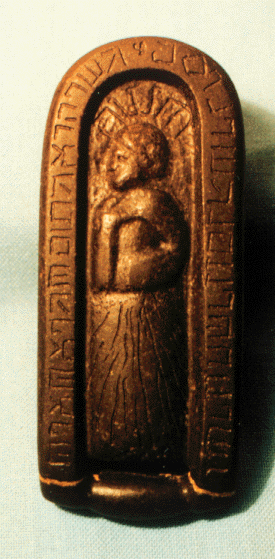
The Ten Commandments dug out of an Ohio mound in 1860
In 1860 David Wyrick, who believed the Lost Tribes of Israel built Ohio’s ancient mounds, dug into the Newark Earthworks and found exactly what he was looking for. In June came the Keystone, inscribed in Hebrew with Holy of Holies, King of the Earth, the Law of God and the Word of God. In November came the Decalogue: a black stone in a sandstone box, carved with a robed, bearded figure labelled Moses and a condensed Ten Commandments running round all its sides. The Keystone’s Hebrew was modern, and Abraham Geiger said so in the New York Times that July. The Decalogue was more convincing, which Kenneth Feder compares to a forged Shakespeare play being exposed and a better one turning up three months later. Who carved them is still argued: Wyrick, whose own woodcut copy of the Decalogue has at least 38 errors, or someone who knew Hebrew far better, perhaps to argue in the slavery debate of 1860 that all people share one origin. The stones can be seen at the Johnson-Humrickhouse Museum in Coshocton, which now presents them as an archaeological fraud.
Johnson-Humrickhouse Museum, Coshocton, Ohio
See it on the map
Other places on the map within a couple of hours of here.
