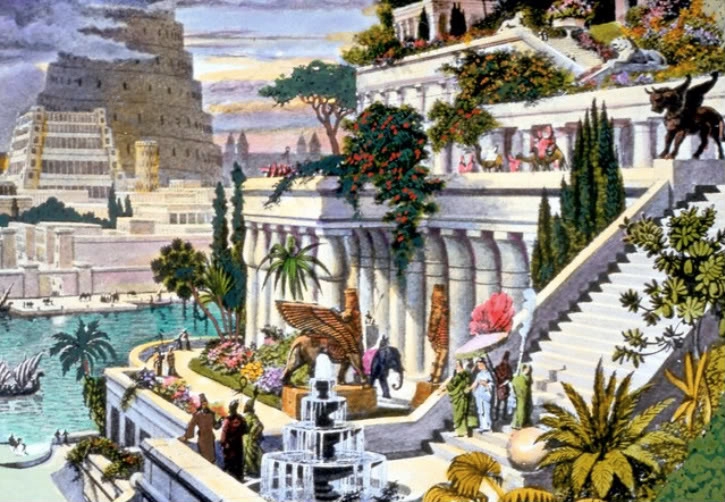
The one ancient wonder never located; possibly at Nineveh instead
The Hanging Gardens of Babylon were one of the Seven Wonders of the Ancient World as the Greeks listed them: tier upon tier of trees, shrubs and vines rising like a green mountain of mud brick in the city of Babylon, near present-day Hillah in Iraq. The name comes from the Greek kremastós, overhanging, meaning trees planted on raised terraces. They are the only one of the Seven Wonders whose location has never been established.
The usual story has the Neo-Babylonian king Nebuchadnezzar II, who ruled from 605 to 562 BC, build them beside his palace for his Median wife, Amytis, who missed the green hills of home. It goes back to Berossus, a priest of Marduk writing around 290 BC, the earliest known mention, quoted by Josephus, who wrote of a pensile paradise planted to look like mountain country. Diodorus Siculus and Quintus Curtius Rufus credit a Syrian king. Diodorus gives a square garden about four plethra on a side with tiers rising 50 cubits behind brick walls 22 feet thick, watered from the Euphrates, and Strabo and Philo of Byzantium describe water raised by screws. Other traditions gave them to the legendary queen Semiramis.
The trouble is Babylon itself. No surviving Babylonian text mentions the gardens, Nebuchadnezzar's long inscriptions describe many works but no garden, Herodotus describes the city without them, and excavation has found no trace; some evidence may lie under the Euphrates, which ran further east in his day. So the gardens may be a romantic ideal of an eastern garden, or they may have stood and been destroyed around the first century AD, or they may have been somewhere else.
That third answer belongs to Stephanie Dalley of Oxford, who after 18 years of study argued, in a book published in 2013, that the wonder was the well-recorded garden of the Assyrian king Sennacherib at his capital, Nineveh, near modern Mosul, some 300 miles from Babylon, built in the early 7th century BC. Its water came through canals, dams and aqueducts from streams 50 miles away; one aqueduct near Nineveh is so vast it looks from the air like a stretch of motorway and bears Sennacherib's own inscription about the watercourse he had built. Ancient texts confused the two kings and the two cities, she argues. She expected her case to divide scholars, and little of Nineveh has yet been excavated.
Babylon (Iraq)
See it on the map
Other places on the map within a couple of hours.
