Desert crocodiles, and 8,000 years of rock art
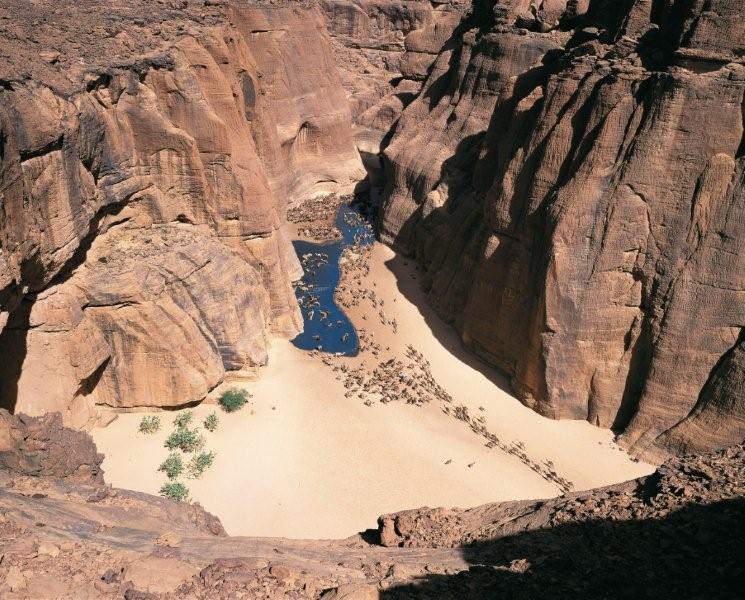
The Ennedi is a sandstone bulwark in the middle of the Sahara, in the far northeast of Chad, some 60,000 km2 of plateau, about as large as Switzerland, rising to around 1,450 m. Water and wind have carved it into canyons and valleys, cliffs, natural arches, bridges, towers and pitons, sandstone laid down from the Cambrian-Ordovician to the Carboniferous over a granite base. In the largest canyons there is permanent water: at least twenty perennial or semi-perennial springs, gueltas and pools, few of them more than a few dozen metres across in the dry season, which keep plants, animals and people alive.
The strangest tenants live in those pools. West African crocodiles, which spread across the Sahara when it was wetter, survive in a few canyon gueltas such as the Guelta d'Archei, cut off so long that they have grown dwarfed; Mongabay counted a relic population of seven. The last lions of the Sahara held on here until the 1940s. Dorcas gazelles remain in small numbers, and at least 199 migratory bird species pass through. Oryx and addax were hunted out, but in December 2023 African Parks and Sahara Conservation released the first ten addax back into the reserve, and camera traps turned up an isolated population of North African ostriches, since reinforced with chicks from Zakouma National Park to make 25 birds by 2022.
On the rock is one of the largest ensembles of art in the Sahara: thousands of images painted and carved on the floors, walls and ceilings of wind-cut shelters, most of them painted, often high up. They can be dated from around 5000 BC onward, and some estimates put the oldest at about 8,000 years. Cattle dominate, the animals that mattered most to the herders who lived here from about 4000 BC, and the climate record shows the land drying around them: rainfall fell from about 250 mm a year 6,000 years ago to about 50 mm by 2,700 years ago, much what it is now. Two semi-nomadic, mainly Muslim groups still bring camels, donkeys, sheep and goats to the gueltas in the rainy months.
UNESCO listed the Ennedi Massif in 2016. In 2018 the Chadian government handed management of the Ennedi Natural and Cultural Reserve to the conservation group African Parks, with money from the European Union and the Dutch Postcode Lottery, and in January 2019 it designated about 50,000 km2 of the plateau as the reserve. Oil exploration has trimmed the protected area and worried UNESCO, and poaching, overgrazing and firewood cutting since the mid-20th century had stripped most of the wildlife; the reintroductions are the first steps back.
Ennedi, Chad
See it on the map
Commons photos · UNESCO World Heritage · GeoNames · OpenStreetMap
