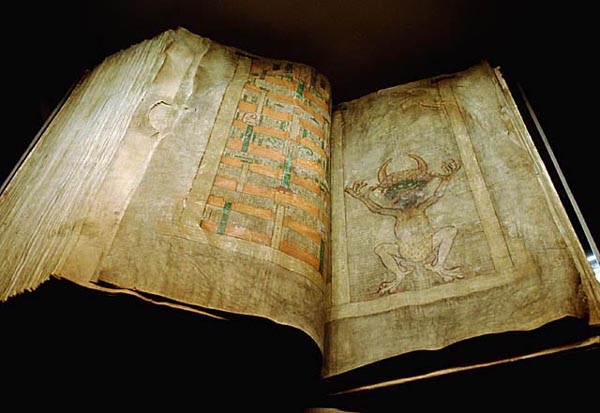
The largest medieval manuscript on Earth, with the Devil painted in it
The Codex Gigas, the giant book, is the largest surviving medieval illuminated manuscript in the world: 92 cm long, 50 cm wide and 22 cm thick, bound in leather-covered wooden boards with ornate metal fittings, and weighing 74.8 kg. Its 310 leaves of vellum are said to come from the skins of 160 donkeys, or perhaps calves. It was written in the early 13th century, generally put between 1204 and 1230, in the Benedictine monastery of Podlažice near Chrast in Bohemia, and holds the complete Latin Bible together with Josephus's Antiquities of the Jews and The Jewish War, Isidore of Seville's encyclopedia, the chronicle of Cosmas of Prague, medical works, and a page of three adjurations and two charms.
It is better known as the Devil's Bible. Folio 290 carries a full-page portrait of Satan, about 50 cm tall, crouching with arms raised, a dark green head capped with curls, red horns and claws, four fingers and toes, and two red tongues from the corners of his mouth. Opposite him is a full page of the Heavenly City. The pages leading up to the Devil have darkened from centuries of light as readers turned straight to him.
The legend, recorded already in the Middle Ages, tells of a monk who broke his vows and was sentenced to be walled up alive. To save himself he promised to write, in one night, a book holding all human knowledge that would glorify the monastery forever. Near midnight, desperate, he sold his soul to Lucifer, who finished the book, and the monk added the Devil's picture in tribute. The even, unchanging hand throughout, with no sign of age or illness in the scribe, may have fed the story. Handwriting analysis points to a single scribe, credited as Herman the Recluse, but one who worked for years, from 10 to 12 by the estimate of Zdeněk Uhlíř of the Czech National Library to more than 20 by others.
The codex was pawned to the Cistercians of Sedlec, reclaimed, and kept at Broumov from 1477 until Emperor Rudolf II took it to Prague in 1594. At the end of the Thirty Years' War in 1648 Swedish troops carried it off from Prague Castle as war booty. When the Tre Kronor castle in Stockholm burned on 7 May 1697, it was saved by being thrown from a window, landing, by one account, on a bystander. It returned to Prague on loan in 2007, after 359 years, and only 60 people an hour were let in for a 10-minute look. It is now kept and displayed at the National Library of Sweden in Stockholm.
The National Library, Stockholm (Sweden)
See it on the map
Other places on the map within a couple of hours.
