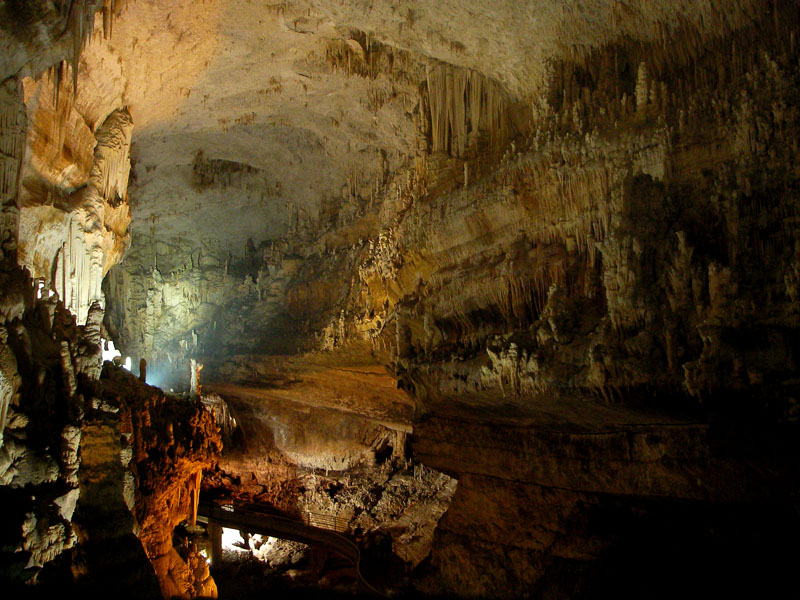
Jeita is two caves rather than one, stacked. The lower grotto and the upper grotto are separate but interconnected karstic limestone caves in the Nahr al-Kalb valley north of Beirut, and they are visited in two entirely different ways.
The lower cave carries an underground river, and you see it by boat. That river is not a curiosity: it supplies fresh drinking water to more than a million Lebanese people, which makes Jeita a working piece of national infrastructure as much as a tourist site.
The upper gallery is walked, and it is the one with the formations. It holds what is generally reckoned to be the world's largest known stalactite, and the chambers are vast enough that the scale is difficult to register from photographs.
The lower cave was rediscovered in 1836 by the Reverend William Thomson, an American missionary, who ventured a short way in and fired a shot to gauge the size of what he was standing in from the echo. The upper galleries were found much later, in 1958, by Lebanese speleologists, and were opened to visitors in 1969.
The war closed it. The caves were shut through the Lebanese Civil War and used for a period as a munitions store, and they did not reopen to the public until 1995.
Jeita was a finalist in the New7Wonders of Nature campaign, and it remains the country's premier natural attraction. Photography inside is prohibited, cameras are held at the entrance, and the temperature stays around 22 degrees Celsius in the upper cave and cooler on the water below. The site is reached from Beirut in well under an hour.
Lebanon
See it on the map
Other places on the map within a couple of hours.
